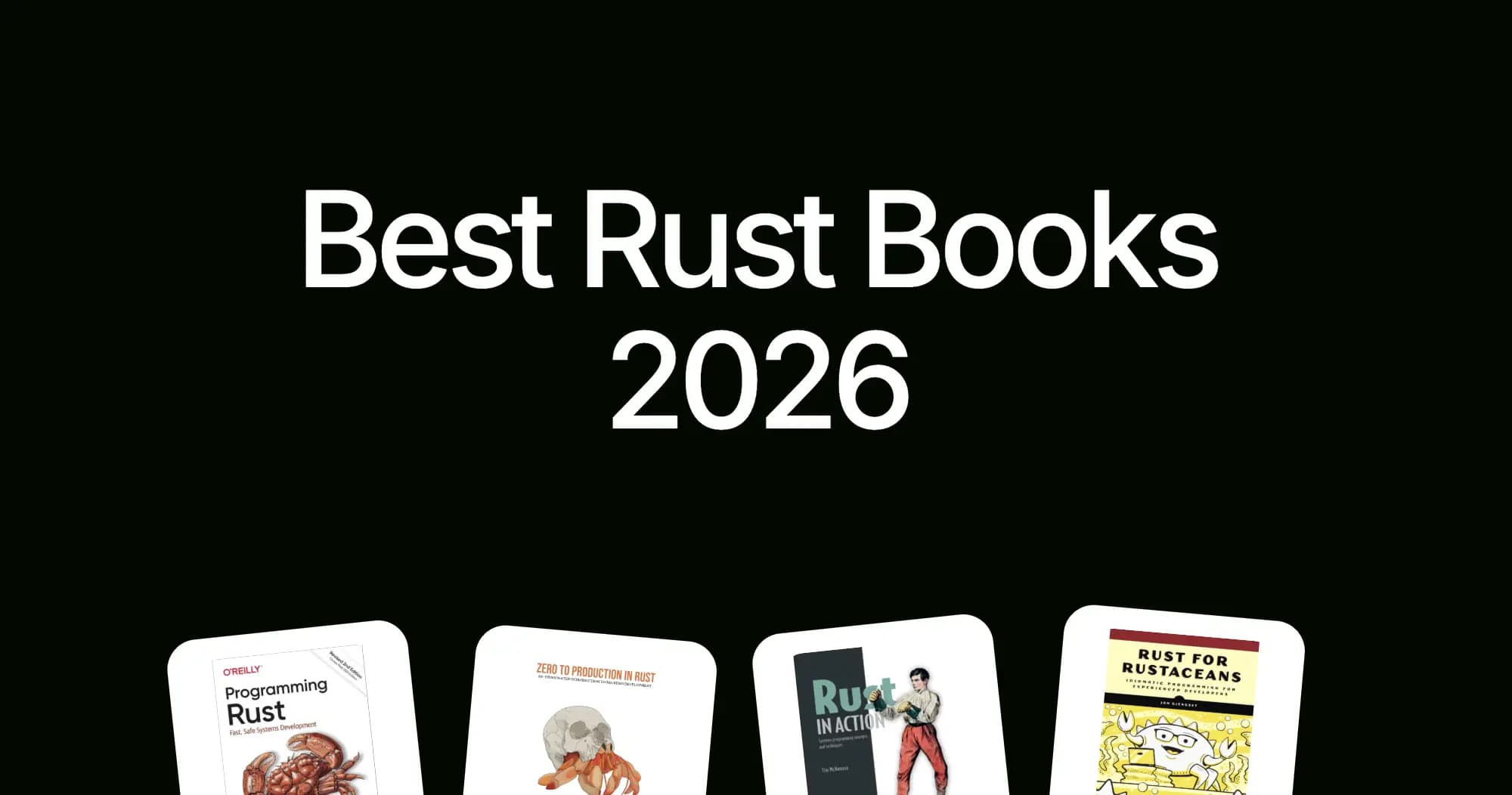
The definitive guide to learning Rust in 2026: free books, paid courses, video series, and community resources: ranked by stage (beginner, intermediate, advanced) and learning style.
Self-study works: The Rust Book (free) + Rustlings (interactive exercises) + Tokio tutorial reaches professional productivity in 4–8 weeks, but structure reduces the 6-month self-study overhead to 10 weeks with mentorship.
By Max Wells, updated July 2026
TL;DR: Start with The Rust Book (free) + Rustlings (interactive exercises). For production web apps, add Zero to Production in Rust. For deep type system understanding, add Programming Rust (O'Reilly). For async: the Tokio tutorial. For advanced Rust: Jon Gjengset's YouTube series.
- Free: The Rust Book, Rust by Example, Rustlings, Tokio tutorial, Comprehensive Rust (Google)
- Best paid book: Programming Rust (O'Reilly): the most complete Rust reference
- Best web dev book: Zero to Production in Rust: REST API with Axum + SQLx + CI
- Best video: Jon Gjengset "Crust of Rust": advanced topics explained by a Rust contributor
- Fastest path: The Rust Book chapters 1–10 + Rustlings → build a project → structured course
Who Should Read This?
This guide is for developers deciding how to invest their learning time in Rust. You might be a software engineer with 3–10 years of experience in Python, JavaScript, Go, or Java who has heard about Rust's growing job market and wants a concrete learning plan. You might be evaluating whether a bootcamp is worth it versus self-study, or comparing specific books before spending money. US senior Rust roles currently pay $185K–$230K, and the supply of qualified candidates remains well below demand: the investment in learning pays back quickly if you pick the right resources. This guide maps specific books and courses to specific learning goals so you spend time on resources that match your current level.
Are Free Resources Enough to Learn Rust Professionally?
Free resources are genuinely sufficient to reach Rust proficiency: the Rust Book, Rustlings, and Tokio tutorial together cover everything required for most professional backend Rust work.
The Rust community has an unusual culture of high-quality free documentation maintained by the language team itself. The Rust Book is not a marketing document with chapters omitted to sell a paid course: it is the official, authoritative reference that core team members contribute to directly. This is unusual. Python, Go, and JavaScript learners typically need paid courses to fill gaps left by incomplete official docs. Rust learners rarely do. The main argument for paid resources is not that the free material is incomplete: it is that paid books offer longer-form exposition, worked examples, and production context that the official docs intentionally omit.
What Free Resources Should You Start With?
The canonical Rust learning path begins with two free resources: The Rust Book for reading and Rustlings for hands-on practice: using them together is significantly more effective than either alone.
The Rust Book (book.rust-lang.org)
The official, authoritative introduction to Rust: written and maintained by the Rust team. Free online at book.rust-lang.org.
- Coverage: chapters 1–20, from hello world through closures, iterators, error handling, generics, traits, lifetimes, smart pointers, concurrency, and macros
- Who it's for: anyone learning Rust: the definitive starting point
- Recommendation: read chapters 1–10 first, build something, then continue
Rustlings (rustlings.cool)
Interactive exercises that match The Rust Book chapters: write code to make failing tests pass. Available at rustlings.cool.
- 96 exercises across ownership, borrowing, enums, options, error handling, generics, iterators, and more
- Install with
cargo install rustlings, run withrustlings watch - Best used alongside The Rust Book: reinforce each chapter immediately
Rust by Example (doc.rust-lang.org/rust-by-example)
Code-first alternative to The Rust Book: every concept shown as runnable code examples. Good supplement, not a replacement.
Comprehensive Rust (google.github.io/comprehensive-rust)
Google's internal Rust training curriculum, now public: covers Android, Chromium, and embedded Rust in addition to the language fundamentals. Four-day course format.
Tokio Tutorial (tokio.rs/tokio/tutorial)
The definitive async Rust tutorial written by the Tokio team: covers async/await, tasks, channels, I/O, and select. Required reading before building any async Rust service.
Which Paid Rust Books Are Worth Buying?
Paid books earn their price through depth, context, and coverage of real production patterns: they do not replace free resources, they extend them.
Programming Rust (O'Reilly): ~$60
The most comprehensive Rust book available: 600+ pages covering the language in depth including ownership, types, traits, error handling, concurrency, and unsafe Rust.
- Author: Jim Blandy, Jason Orendorff, Leonora Tindall
- Edition: 2nd ed. (2021, covers Rust 2021 edition: largely current)
- Who it's for: developers who want to understand Rust deeply, not just learn the syntax
- Covers topics The Rust Book glosses over: the memory model, operator overloading, trait objects, string types, closures in detail
The book's strength is its depth on topics that the official documentation treats lightly. The chapters on closures, iterators, and the memory layout of types are among the best written explanations available anywhere. If you want to understand why Rust is designed the way it is: not just how to use it: this is the book.
Zero to Production in Rust: ~$30
Builds a production-quality email newsletter API from scratch: Axum, PostgreSQL, SQLx, Docker, CI/CD, telemetry, authentication, emails.
- Author: Luca Palmieri (former Principal Engineer at Cookpad/TrueLayer)
- Website: zero2prod.com
- Who it's for: developers who want to build real Rust web services: the most practical Rust book for backend developers
- Updated for Axum in 2024 (originally actix-web)
This book is the closest Rust equivalent to a structured bootcamp in book form. It covers not just code but the entire lifecycle of a production service: database migrations, integration tests, CI configuration, health checks, and observability. Developers who complete it have a complete reference implementation they can adapt for their own projects.
Rust in Action: ~$50
Focuses on systems programming: file systems, networking, time, processes, kernel interaction. Good for developers coming from C/C++ systems backgrounds.
- Author: Tim McNamara
- Who it's for: systems programmers who want real low-level examples
Rust for Rustaceans: ~$50
Advanced book for developers who already know Rust basics: covers the type system deeply, unsafe Rust, macro writing, API design, and library authorship.
- Author: Jon Gjengset (core Rust contributor)
- Who it's for: intermediate Rust developers who want to write library-quality code
What Are the Best Video Resources for Learning Rust?
Video learners have excellent options at both beginner and advanced levels: the quality of free Rust video content is unusually high compared to other languages.
Jon Gjengset: Crust of Rust (YouTube)
Livestream series covering advanced Rust topics in depth: the best free advanced Rust content available.
- Topics: iterators, smart pointers, lifetimes, declarative macros, dispatch, atomics, async
- Style: long-form (2–4 hours): watching him implement and debug real code
- Channel: youtube.com/@jonhoo
- Who it's for: intermediate developers who've completed The Rust Book and want to go deeper
The Crust of Rust series is valuable precisely because Gjengset shows his thinking process while working through complex code, including moments of confusion and backtracking. This is more realistic and educational than polished tutorial videos where everything works on the first try.
Let's Get Rusty (YouTube)
Beginner-friendly series following The Rust Book: good for developers who prefer video over text.
- Channel: youtube.com/@letsgetrusty
- Covers chapters of The Rust Book in video format
No Boilerplate (YouTube)
Short, opinionated Rust videos: great for motivation and ecosystem overview.
- Channel: youtube.com/@NoBoilerplate
- Best for: developers deciding whether to invest in Rust
What Community and Reference Resources Should You Bookmark?
Beyond books and courses, a small set of community resources should stay permanently open in your browser throughout your Rust learning journey.
| Resource | URL | What it's for |
|---|---|---|
| Rust documentation | doc.rust-lang.org | Standard library reference: always open |
| docs.rs | docs.rs | Documentation for every crate on crates.io |
| Rust Users Forum | users.rust-lang.org | Questions, discussion: active, welcoming |
| Rust Discord | discord.gg/rust-lang | Real-time help: #beginners channel is excellent |
| r/rust | reddit.com/r/rust | News, projects, discussion |
| This Week in Rust | this-week-in-rust.org | Weekly newsletter: ecosystem updates |
| Rustacean Station | rustacean-station.org | Podcast: interviews with Rust contributors |
What Are the Recommended Learning Paths?
Different goals require different paths: pick the one that matches your target outcome rather than trying to read everything.
Path A: Web Developer (2–4 months)
- The Rust Book ch. 1–10 + Rustlings (4 weeks)
- Tokio tutorial (1 week)
- Zero to Production in Rust (4–6 weeks)
- Build your own REST API project
Path B: Systems Developer (3–6 months)
- The Rust Book complete (6 weeks)
- Programming Rust (O'Reilly) (4 weeks)
- Rust in Action (3 weeks)
- Build a systems project (CLI tool, network scanner, parser)
Path C: Structured bootcamp (10–12 weeks)
- A structured program with curriculum, mentorship, and project reviews
- Eliminates the 30% navigation overhead of self-study
- Compresses the typical 6–12 month self-study to 10–14 weeks
What Common Mistakes Do Rust Learners Make When Choosing Resources?
The most common learning mistakes are not choosing bad resources: they are using good resources in the wrong order or skipping the practice that makes reading stick.
-
Reading The Rust Book cover-to-cover before writing code. The most common beginner mistake. Rust concepts like ownership and borrowing require muscle memory built through writing and debugging code, not passive reading. Read a chapter, do the Rustlings exercises for that chapter, then continue. The combined Book + Rustlings approach completes in roughly the same time as reading alone but produces dramatically better retention.
-
Starting with an embedded or systems project as your first Rust code. These domains add domain complexity (hardware registers, no_std, linker scripts) on top of Rust complexity. Your first projects should be CLI tools or web APIs where the feedback loop is fast and the error messages are clear. Save embedded for after you are comfortable with the borrow checker.
-
Abandoning the Rust Book when lifetimes become difficult. Lifetime annotations appear in chapters 10–11 and cause many learners to stall. The key insight: you rarely need explicit lifetime annotations in application code: they appear mainly in library code. Continue through the rest of the book; the difficulty eases after chapter 13, and lifetime annotations become mostly mechanical patterns.
-
Buying every book at once. The Rust book ecosystem is comprehensive but overlapping. Buying Programming Rust, Zero to Production, Rust for Rustaceans, and Rust in Action simultaneously leads to paralysis about which to read first. Buy one book, complete it, then buy the next. Start with Zero to Production if you want web development; start with Programming Rust if you want deep language understanding.
-
Skipping the Tokio tutorial and learning async through osmosis. Many developers learn enough async Rust to make things work without understanding the executor model, task scheduling, or cancellation semantics. This produces code that works in tests but fails under production load (not cancelling tasks properly, blocking the executor with sync code). Spend one week on the official Tokio tutorial: it prevents months of debugging.
-
Using Reddit or Discord as the primary reference instead of docs.rs. Community answers are often correct for older crate versions but wrong for current APIs. Every crate question should start with docs.rs, not a search engine. The documentation on docs.rs is always built from the actual source of each published version: it is authoritative by definition.
How Should You Structure Your Learning Path?
The difference between 3 months and 12 months of learning is not the quality of resources: it's having a clear sequence, not guessing what to learn next.
The self-study advantage: work at your own pace, free or low cost, unlimited time to think deeply.
The self-study friction: navigating 150,000 crates, choosing which book next, debugging errors alone, writing practice code that never gets reviewed.
A structured learning path (bootcamp, mentorship, group cohorts) eliminates the 30% navigation overhead and keeps you progressing toward a specific goal: deploying a real project and landing a Rust role. Rustify's 9-week bootcamp compresses the typical 6–12 month self-study timeline to 10–14 weeks with 1:1 mentorship, project feedback, and real deliverables reviewed by production Rust engineers.
Keep Reading
- Rust Developer Salary in the USA (2026)
- How Long to Learn Rust by Background: Hours, Timeline & ROI
- Best Way to Learn Rust in 2026
- Is Rust Hard to Learn?
Frequently Asked Questions
No: read chapters 1–10, then build something. Return to the book for reference when you hit specific problems. Reading without coding doesn't build muscle memory for the borrow checker. Alternate: read a chapter, do the Rustlings exercises for that chapter, repeat.
The Embedded Rust Book (docs.rust-embedded.org) is the official resource: covers no_std, hardware abstraction layers, and bare-metal programming. For Embassy (async embedded), the Embassy documentation and examples are the best resource.
The Rust Book + Rustlings: 4–8 weeks at 10 hours/week. Zero to Production: 4–6 weeks. Programming Rust: 6–8 weeks. Most developers don't read everything: pick the path most relevant to your goals.
Zero to Production for most Python developers. It focuses on building a complete web service, which maps well to how Python developers typically work. Programming Rust is the deeper language reference: it is more valuable after you can already write working Rust and want to understand why it works. Read Zero to Production first, then Programming Rust if you want to go deeper on the type system.
The official Rust Book has a chapter on macros (chapter 19), but it is brief. For declarative macros, the Little Book of Rust Macros (veykril.github.io/tlborm/) is the best free resource. For procedural macros, Jon Gjengset's Crust of Rust YouTube series has dedicated episodes that show the implementation process in real time.
Programming Rust 2nd edition (2021) is mostly current: Rust's core language has been stable since the 2021 edition. Zero to Production was updated in 2024 for Axum and remains current. The biggest risk of staleness is in crate API chapters, where version numbers and specific API calls may have changed. Always cross-reference with docs.rs for the specific crate version you are using.
Start with the Rust Book chapters 1–10, but move faster than a Python developer would: the ownership model maps closely to what you already understand from manual memory management. The meaningful new concepts for C++ developers are the borrow checker's compile-time enforcement, the trait system (vs virtual dispatch), and the async model. Rust for Rustaceans is a natural second book once you are comfortable with basics.
The Polars library (polars.rs) has good documentation for DataFrame-style data processing in Rust. The Arrow2 crate provides Apache Arrow integration. For learning material, the existing general Rust resources are sufficient: data engineering in Rust uses the same language features as other domains, with Polars and Arrow providing the domain-specific tools.